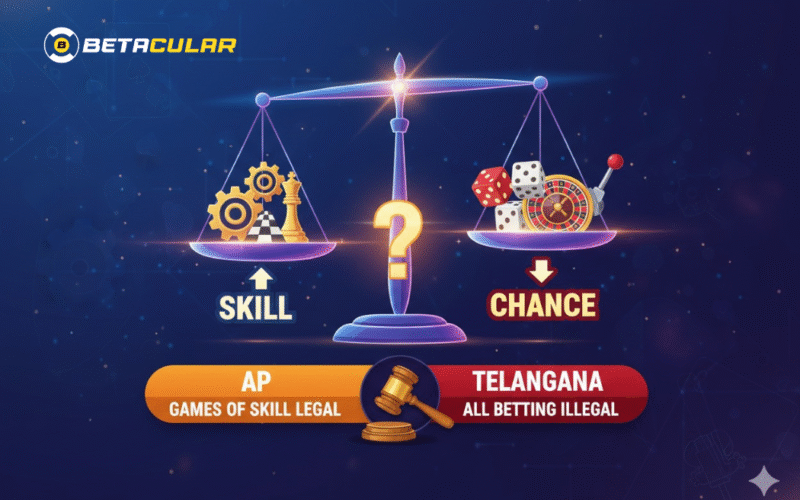
The distinction between a Game of Skill and a Game of Chance has long been the cornerstone of the Indian legal approach to gaming. Yet, nowhere is this line more sharply drawn, and more highly contested, than in the southern states of Andhra Pradesh (AP) and Telangana.
For years, platforms like Betacular and the entire online fantasy sports industry relied on judicial precedent upholding skill-based games. However, a major central law passed in 2025 has dramatically shifted the landscape, creating a conflict between state and central authority. Understanding this legal flux is essential for anyone interested in the AP Telangana gaming market.
The State Stance: Prohibition is the Law
Both Andhra Pradesh and Telangana have historically taken a hardline stance against online real-money gaming, regardless of the ‘skill’ argument.
- Telangana Gaming Act (Amended 2017): Telangana was the first state to amend its Gaming Act to ban all forms of online gaming played for money or stakes, including skill-based games like online rummy and fantasy cricket. The law essentially erased the distinction between skill and chance, treating all as illegal gambling.
- Andhra Pradesh Gaming Act (Amended 2020): Following Telangana’s lead, AP amended its own Act to prohibit online gaming involving wagering money.
- The Intent: Both states acted primarily to curb social issues like addiction, financial ruin, and suicide linked to Real Money Games (RMGs).
In these states, the traditional “predominance of skill” test, which made fantasy sports legal elsewhere, was effectively set aside by state legislature.
The Central Law Earthquake: The 2025 Act
The legal landscape became exponentially more complex with the passage of the Promotion and Regulation of Online Gaming Act, 2025. This central law created a national framework that directly impacts state prohibitions:
- Blanket Ban on ‘Online Money Games’: The 2025 Act prohibits any online game played for money or stakes, irrespective of whether it is based on skill or chance. This provision appears to validate the spirit of the bans already in place in AP and Telangana.
- Focus on Enforcement: The Act introduces severe penalties, making it a cognizable and non-bailable offense to promote, advertise, or transfer funds for such games. It also allows for the blocking of illegal offshore platforms.
- Promotion of E-Sports and Social Games: The Act formally recognises and encourages E-Sports and Online Social Games (without monetary stakes), clearly separating them from prohibited money games.
The Legal Battleground: Article 19(1)(g)
The current legal fight has shifted to the Supreme Court, where various petitions challenging the 2025 Act have been transferred:
- Constitutional Challenge: Operators are arguing that banning skill-based games (like Fantasy Sports, Poker, and Rummy, which have been upheld as skill by various High Courts) violates the fundamental Right to Practice any Profession or Trade under Article 19(1)(g) of the Constitution.
- Federalism Challenge: The laws in AP and Telangana (and the new central law) also face a challenge over legislative competence, as ‘betting and gambling’ falls under the State List of the Constitution. The Supreme Court is tasked with reconciling the state-level bans, the central law, and fundamental constitutional rights.
- The Wait: As of late 2025, the Supreme Court is actively hearing the comprehensive challenge, meaning the definitive legal status of online gaming in AP and Telangana is now pending a final judicial pronouncement.
Betacular’s Insight: What Does This Mean for the User?
In Andhra Pradesh and Telangana, the legal reality is clear: playing online games for real money or stakes is currently prohibited under state and central law.
The traditional distinction between Games of Skill vs Games of Chance is currently irrelevant in these states’ legislative framework, as both types of money games are banned. Until the Supreme Court delivers its final verdict, the market remains shut for real-money gaming operators.
For platforms like Betacular, compliance is paramount. The focus shifts to E-Sports and social/free-to-play fantasy leagues—the only safe and legal avenues for fan engagement in the region.